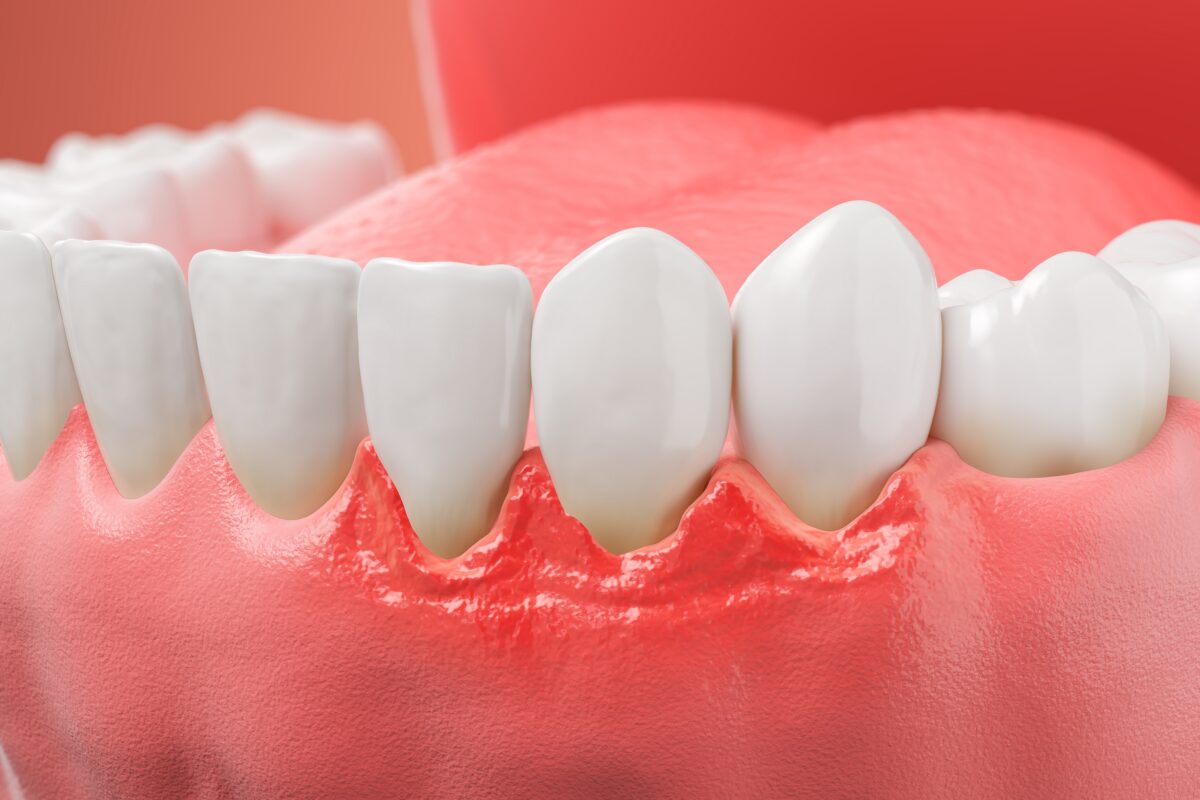
Have you ever thrown a party, and a few guests overstayed their welcome? At first, it’s no big deal. But the longer they linger, the more mess they leave behind and the harder it becomes to restore your home to normal. Gum disease actually works in a similar way. When plaque builds up along your gumline, it brings harmful bacteria with it. If those bacteria aren’t removed, they settle into the gums (gingiva) and trigger inflammation. Over time, the infection can damage the tissue and bone that support your teeth. Left untreated, it may lead to abscesses, a receding gumline, and even tooth loss. Years ago, surgery was the only way to treat gum disease once it advanced to more severe stages. Today, we offer a less invasive option: Waterlase laser therapy.
With the Waterlase®, Dr. Stingley can treat gum disease much more comfortably. This advanced technology enables her to remove infected tissue more precisely while keeping the procedure minimally invasive.
Understanding Gum Disease
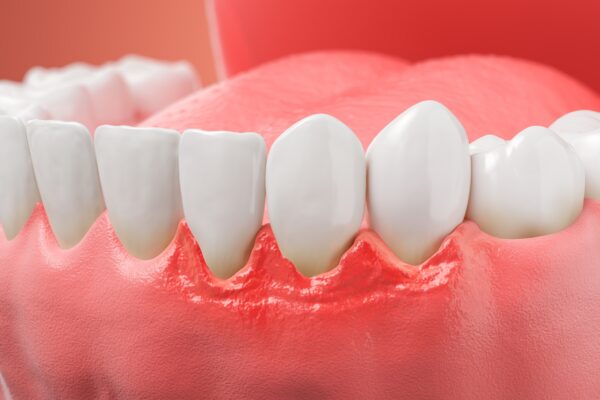 What do healthy gums look like? Healthy gums are firm and fit snugly around your teeth. They don’t look swollen or puffy, and they shouldn’t bleed easily when you brush or floss.
If you’ve noticed that your gums bleed when brushing or flossing, look red and inflamed, or feel soft and spongy, you could be in the earliest stages of gum disease, which is known as gingivitis.
When Dr. Stingley detects the first signs of gum disease, she will advise you on at-home treatment with proper cleaning and saltwater rinses.
However, if gum disease progresses to early periodontitis, the infection can slowly break down the bone that supports your teeth. As the bone level lowers, the gums lose the firm support beneath them. This causes the gums to pull away from the teeth, creating pockets where bacteria can collect. You may notice more frequent bleeding or changes along the gumline at this point. If the condition advances to moderate or severe stages, continued bone loss can cause teeth to loosen or shift out of place.
Once periodontitis develops at any level, it will not resolve on its own. You’ll need to see Dr. Stingley to stop the infection and prevent the damage from worsening.
At one time, surgery was the main option for treating moderate to advanced periodontitis. But with the Waterlase® laser, Dr. Stingley provides a more comfortable solution.
What Is the Waterlase Laser?
You may not have heard of the Waterlase® laser, but it’s been used in dentistry for decades. This minimally invasive technology offers a safe alternative to traditional drills and scalpels. In fact, the FDA first cleared it for use in 1998.
This dental laser system combines an infrared laser with a fine water spray to cut through tissues without the sensation of heat, heavy vibration, or drilling. It’s approved to perform over 80 procedures on hard tissue (enamel, dentin, bone) and soft tissue (gums).
During Waterlase treatment, you may experience a light tapping or vibrating sound, minimal warmth, and a cool water spray sensation. It’s so gentle that you may not even need local anesthesia for your procedure.
Dr. Stingley is especially passionate about using this powerful but gentle laser to treat periodontitis. She follows the REPAIR Perio™ protocol to treat periodontal disease using the Waterlase laser. For the most advanced periodontitis, where heavy bone loss has already taken effect, a more traditional oral surgery may still be the best option. At your free screening, Dr. Stingley will happily explain the best options for your specific needs.
How Waterlase Treats Periodontitis
How does the Waterlase® REPAIR Perio protocol treat gum disease?
Dr. Stingley uses the laser to target diseased tissue, vaporizing infected areas and effectively killing up to 99% of bacteria in the gums.
With this protocol, she can treat many cases of periodontitis in one to two visits. The treatment time for these laser-enhanced treatments is also 20% shorter than surgical interventions.
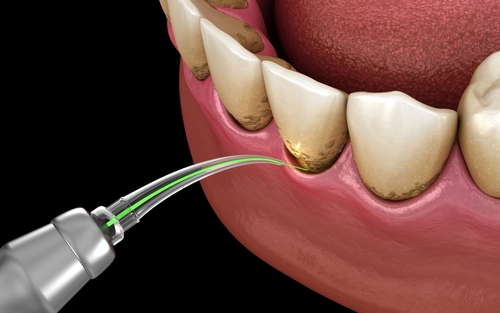
As the first step in Waterlase treatment, Dr. Stingley will perform a comprehensive exam and develop your personalized treatment plan. Next, she will perform a deep cleaning to remove plaque and prepare for the next phase.
Then, she will use the Waterlase to remove debris and bacteria between your gums and teeth. This process, called degranulation, removes the infection in the diseased gum pockets. She won’t need to make any large incisions into the gums. Finally, she will recontour any bone defects and apply a compress to the site.
The REPAIR protocol has been shown to be as effective as surgical approaches. But patients experience less bleeding, swelling, and bruising afterward. Given these improvements, the Waterlase provides a gentle yet effective way to remove bacteria from your gums.
If gum disease is making you feel like the bacteria in your mouth are overstaying their welcome, Dr. Stingley can help you! She proudly uses the advanced Waterlase laser to treat gum disease comfortably, quickly, and effectively.
Book a Free Screening To Drive Out Gum Disease!
Gum disease begins when harmful bacteria settle into your gums and start building their own community. As that bacterial community grows, it triggers inflammation and gradually damages the tissue that supports your teeth. The sooner you disrupt it, the better! With Waterlase® laser treatment, Dr. Stingley can precisely target and remove infected tissue, helping to break up the infection before it spreads further. This advanced technology is gentle on healthy tissue and helps restore your oral health without the hassle of oral surgery.
Wondering if Waterlase laser therapy is the best treatment for you? The answer depends on the stage of your gum disease and your overall oral health. Dr. Stingley will evaluate your needs and determine whether this minimally invasive option is right for you. To take the next step, book a free screening at Carter-Rockbridge General Dentistry.